
PTK Endorsed Solutions
PTK Endorsed Solutions highlights trusted organizations, proven tools, and promising approaches that are helping make transfer work better. Discover partner perspectives, success stories, and practical solutions for strengthening transfer recruitment and student outcomes, including select benefits and preferred pricing available to PTK members.

Recognition as a lever for improving transfer.
Presented by MyDocs, featuring Merrimack College
Published September 8, 2026
Transfer students are often asked to make important enrollment decisions before they understand how their previous coursework may apply, how long it could take to complete their degree, or what their path forward might look like.
For high-achieving community college students, including Phi Theta Kappa members, this uncertainty can influence where they apply, enroll, and how confident they feel in their decision.
At the same time, four-year institutions are under pressure to recruit transfer students more effectively while managing manual transcript review processes, inconsistent formats, multiple grading scales, and limited staff capacity.
Improving the transfer experience requires more than attracting students. Institutions must also provide timely information that helps students understand their options.
The Transfer Decision Starts Before Application
Many institutions still treat transcript evaluation as a process that begins after a student applies or deposits. By then, the student may already be comparing institutions and considering:
- How many credits might transfer
- Whether courses will apply toward a program
- How long degree completion could take
- What additional coursework may be required
Institutions that provide greater clarity during recruitment can build trust, improve engagement, and demonstrate their commitment to transfer student success.
This does not mean replacing the formal evaluation conducted by registrars or academic departments. Instead, institutions can use preliminary, policy-informed insight to support meaningful conversations before the official evaluation is complete.
From Static Documents to Structured Academic Data
A major barrier to earlier transfer insight is the transcript itself.
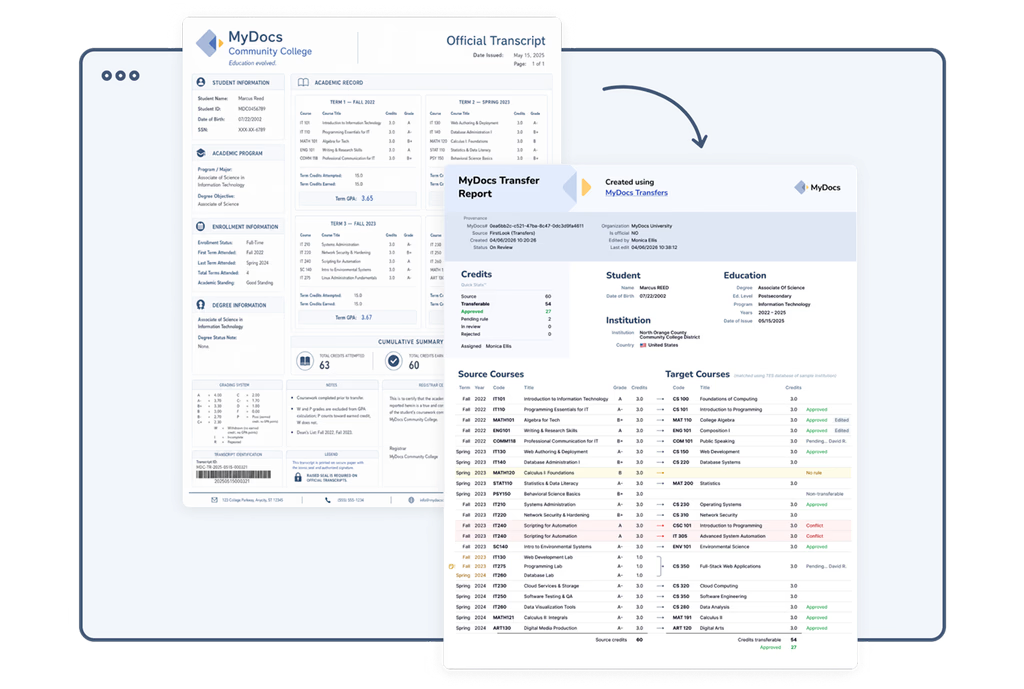
Transcripts arrive in different layouts, formats, languages, and grading systems. Staff often must manually locate courses, credits, grades, and academic levels before applying transfer policies or reviewing equivalencies.
Technology can transform static transcript documents into structured academic data that institutions can use across recruitment, admissions, evaluation, and student support workflows.
Structured transcript data may include:
- Institutions attended
- Courses and subject areas
- Credits attempted and earned
- Grades and grading scales
- Academic terms and GPAs
Once transcript information is structured, institutions can apply their own policies, equivalency rules, and review processes more consistently. This can reduce repetitive data entry and improve the flow of data into admissions systems.
Four Ways to Strengthen Transfer Recruitment
1. Make transcript insight part of recruitment
Transfer recruiters may use preliminary insight to discuss how a student’s coursework could align with a program. Admissions teams may also use transcript data to personalize outreach or identify students suited for specific academic pathways.
The goal is not to make a final decision during recruitment. It is to give students enough meaningful information to move forward with greater confidence.
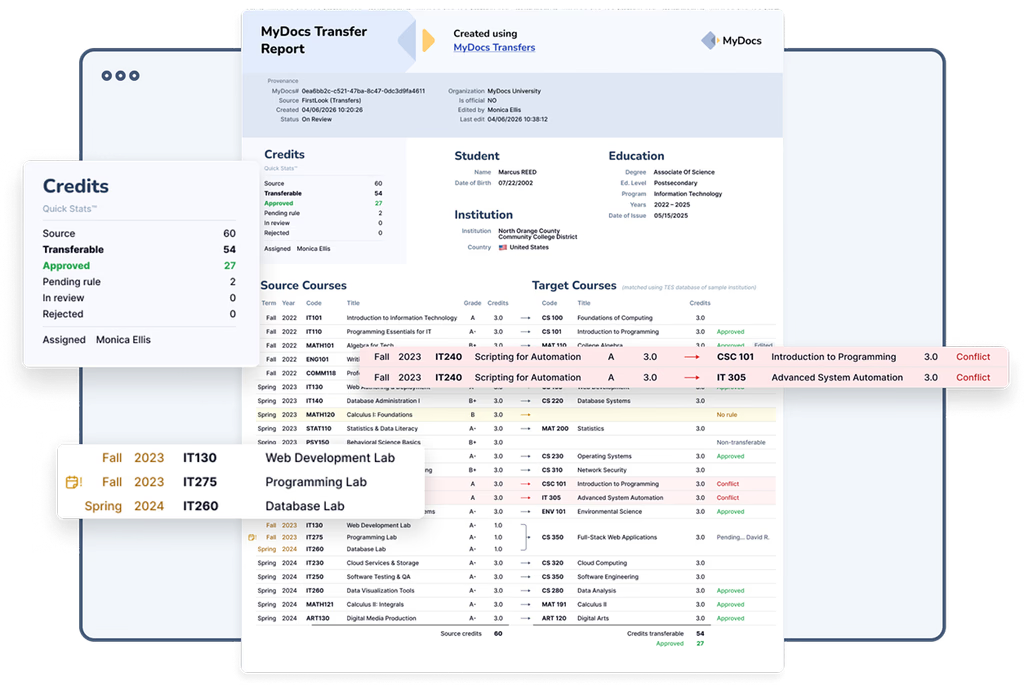
2. Clearly distinguish preliminary and official evaluations
Students should understand when information is preliminary, which policies were used, which courses have established equivalencies, and which items still require review.
Clear explanations allow institutions to provide useful guidance without creating confusion about the official evaluation process. This distinction also helps admissions, registrar, and academic teams maintain appropriate roles.
3. Connect transfer data across systems
Transcript data is most valuable when it does not remain isolated in a document or separate platform.
Institutions should consider how structured academic data connects with their CRM, SIS, transfer equivalency database, and communication workflows. Better connectivity can reduce duplicate work, improve consistency, and support students throughout recruitment and enrollment.
CRM and marketing teams may also use approved data points to create more relevant communication journeys for prospective transfer students.
4. Measure operational and student outcomes
Operational measures may include processing time, staff hours spent on manual review, time from transcript receipt to preliminary insight, and the percentage of transcripts processed without correction.
Student-facing measures may include inquiry-to-application conversion, application completion, enrollment yield, time to decision, persistence, and completion.
Institutions should define the outcomes they want to improve before introducing new technology or processes.
A Four-Year Institution Perspective
Merrimack College has used MyDocs to reduce the administrative burden associated with transcript processing and make academic information available earlier in its admissions workflows.
Across nearly 15,000 transcripts, Merrimack reported an 80% reduction in transcript review time, with approximately 84% requiring no manual review. The institution estimated that these efficiencies saved more than 800 staff hours.
These results demonstrate how structured transcript data can support institutional capacity while creating opportunities for earlier student engagement.
Partner perspective:
“Enrollment leaders are being asked to shape their class, build their financial aid model, and make projections earlier every year. MyDocs allows us to understand the quality of our pool months earlier than we would have previously, which allows for us to make better, more informed decisions.”
Gianna Voccola
Sr. AVP for Enrollment Management and Dean of Undergraduate Admission
Merrimack College
Building a More Transparent Transfer Experience
When institutions provide clearer information earlier, students can make more informed decisions, recruiters can have more productive conversations, and admissions teams can spend less time locating and re-entering transcript information.
The strongest transfer strategies combine technology, institutional policy, cross-functional collaboration, and a commitment to the student experience.
For Phi Theta Kappa members and other high-achieving community college students, greater transparency can reduce uncertainty and make the transition to a four-year institution feel more achievable.
About MyDocs
MyDocs helps colleges and universities transform transcripts into standardized, structured academic data that supports admissions, transfer, and student engagement workflows across all student populations, including first-year, transfer, graduate, and international students.
The platform extracts and organizes transcript information across formats, grading systems, countries, and languages. Institutions can use that data to support earlier transfer insight, apply their own policies and equivalencies, reduce manual transcript handling, and connect information with admissions systems.
MyDocs provides data and insight to support institutional processes. Official transfer credit decisions remain with each institution.
Explore the interactive transfer demo: https://mydocs.global/guide-transfer
PTK Preferred Pricing: Mention PTKPartner when contacting MyDocs to receive preferred pricing.
Website: MyDocs.Global
Primary Contact: Jeff Meece, Ed.D., Vice President for Partnerships
Email: jeff.meece@mydocs.global
Schedule a Conversation: https://go.mydocs.global/book-a-demo