
Insights and Perspectives
Insights and Perspectives brings together thought leadership designed to help four-year institutions think differently about transfer, strengthen their efforts, and explore new possibilities through partnership with PTK. Discover fresh perspectives, practical strategies, and lessons from the field that are shaping the future of transfer.
Recognition as a lever for improving transfer.
Published July 30, 2026
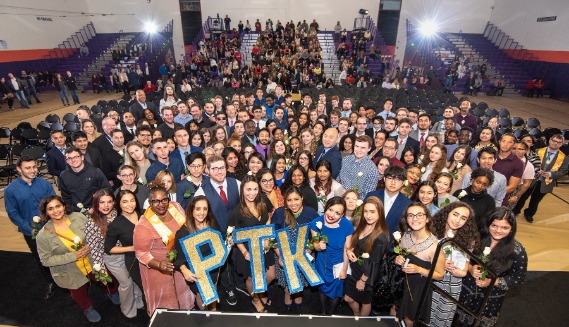
Community colleges began as junior colleges, intended to provide the first two years of a bachelor’s degree before students transferred to a university. More than a century later, vertical transfer remains one of higher education’s most persistent challenges. We continue to debate how to improve transfer through initiatives such as articulation agreements, transfer admission guarantees, advising reforms, funding incentives and accountability measures. These efforts matter, but they also raise an important question: How do we know when they are working, not individually, but collectively?
What if we’ve been overlooking another critical lever for change? What if improving transfer begins not only with designing better policies and practices, but also by recognizing and celebrating the institutions where those efforts are producing exceptional results?
Never underestimate the power of recognition to drive behavior change. Policy establishes expectations, but recognition shapes aspirations. Colleges and universities are constantly striving to improve, and public recognition validates those efforts while signaling excellence to others. Students notice it. Parents notice it. Presidents notice it. Boards notice it. Recognition influences institutional priorities and creates focus.
Higher education has long understood the importance of recognition. Institutions proudly celebrate athletic championships, national rankings, prestigious grants, faculty fellowships, research designations or student achievement awards. If recognition can elevate so many aspects of institutional excellence, why shouldn’t it also be used to strengthen transfer success?
And if recognition already influences institutional behavior in so many areas, why haven’t we used it more intentionally to improve the transfer learner experience and drive outcomes? Rather than beginning with institutions that struggle, what if we first identified those that consistently help transfer students succeed, celebrated the factors that contributed to their accomplishments and encouraged others to emulate them? This asset-based approach does not ignore problems. Instead, it identifies excellence, makes it visible and creates incentives for others to follow.
Phi Theta Kappa, the international honor society for high-achieving community college students, has spent the past decade using recognition as a lever to improve transfer. Guided by the belief that students and institutions often improve because they aspire to be recognized for exceptional work, PTK launched the Transfer Honor Roll to recognize four-year colleges and universities that demonstrate excellence in serving transfer students.
The Transfer Honor Roll evaluates institutions on five dimensions that matter most to community college transfer student success. These areas were informed by years of research and experience working with high-achieving community college students and university partners to better understand the factors that consistently contribute to successful transfer. Rather than measuring a single policy or practice, the framework uses more than 40 indicators, including credit applicability, to assess how well institutions support transfer students across the entire transfer journey.
The five dimensions include:
- Success outcomes after transfer
- Campus friendliness and sense of belonging
- Availability of need- and merit-based financial aid
- Acceptance and application of transfer credit toward degree completion
- Overall recruitment/admissions experience and campus life for transfers
When the initiative began in 2015, fewer than 50 institutions participated. This year, 1,117 four-year colleges and universities submitted their transfer profiles for consideration. The evaluation also incorporates National Student Clearinghouse transfer outcome data into the evaluation process, recognizing institutions whose transfer outcomes rank among the nation’s strongest. (See the 2026 Transfer Honor Roll announcement for the full list of recognized institutions.)
Recognition is upstream intervention. It influences institutional priorities before policies or regulations ever mandate change. The remarkable growth of the Transfer Honor Roll demonstrates that institutions respond when excellence is recognized. They benchmark themselves against peers, evaluate their own transfer policies, strengthen student supports and continuously improve the transfer experience. Recognition does not replace policy. It accelerates institutional attention, innovation and improvement.
States should pay attention. Instead of asking only, “How do we improve transfer?” we should also be asking, “How do we recognize institutions that are already doing it well?” States have many options, including statewide transfer recognition programs, performance funding that rewards strong transfer outcomes, public recognition of institutions that excel in serving transfer students and scholarship incentives that encourage student mobility.
These approaches not only encourage continuous improvement but also make excellence visible to students and families. Done well, they help a state’s colleges and universities attract talented transfer students, improve transparency for taxpayers and create healthy competition around one of higher education’s most important outcomes.
Higher education has never lacked ideas for improving transfer. Recognition alone will not solve the transfer challenge. But for generations, recognition has shaped institutional behavior, inspired innovation and elevated excellence across higher education. If we want more institutions to become places where transfer students thrive, perhaps it is time to recognize them for doing exactly that.
By Lynn Tincher-Ladner, Ph.D.
Published July 8, 2026
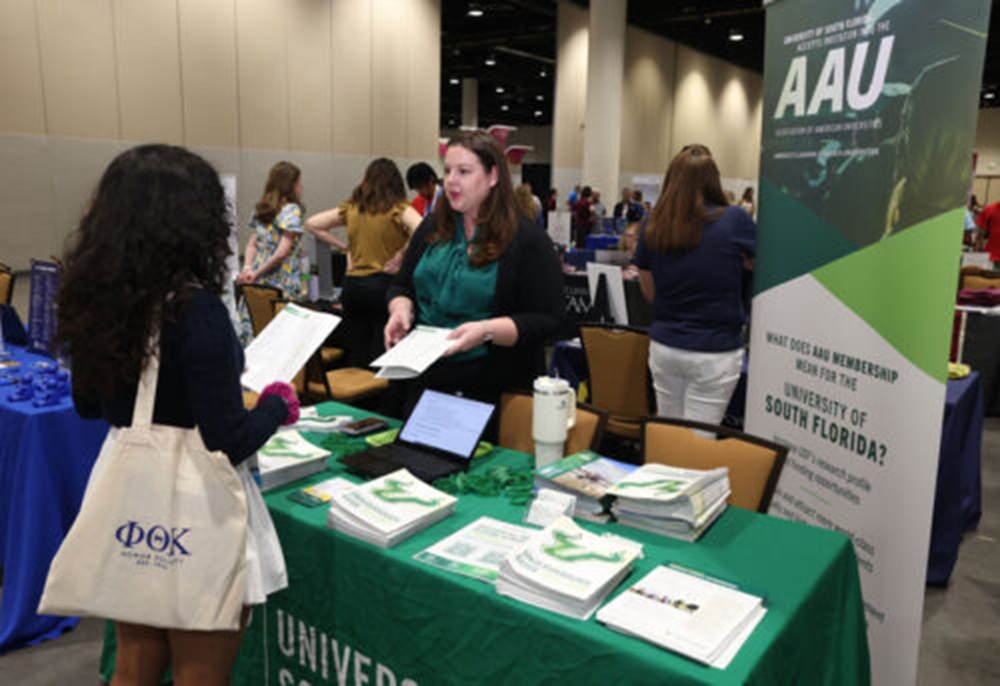
Recognition opens doors. Connection changes lives.
At Phi Theta Kappa, we believe academic recognition is only the beginning. When students are recognized for their achievement and connected to engaged faculty, dedicated advisors, supportive peers, and meaningful opportunities, they become more deeply invested in their education. That engagement strengthens persistence, completion, and successful transfer to a bachelor’s degree.
PTK members have already demonstrated they can succeed in college. Our role is to help them build on that success by deepening their engagement and connecting them with universities where they can continue to thrive.
This year, that opportunity became even greater for our university partners.
Compared to the previous academic year, PTK’s pipeline of high-achieving student members expanded by 18% nationwide, creating more opportunities than ever for university partners to recruit academically accomplished community college students.
The story isn’t just that the pipeline is growing. It’s that the students entering that pipeline need university partners more than ever.
- 25% more first-generation college students, bringing thousands more talented students who often benefit from guidance as they navigate the transfer process.
- 24% more students receiving Pell Grants, highlighting an expanding population of academically accomplished students with significant financial need.
- 22% more students balancing work and college, demonstrating determination, resilience, and the drive to succeed.
- 15% growth in dual enrollment members, expanding the future pipeline of transfer-ready students.
Where the Pipeline Expanded Most
Growth was broad-based across the country, with PTK membership increasing in 47 states and territories. The strongest percentage gains occurred in Idaho, Indiana, Massachusetts, Georgia, Tennessee, Rhode Island, Wyoming, Minnesota, Nebraska, and Vermont. Among our largest membership states, California, Florida, North Carolina, Texas, and Massachusetts added the greatest number of new PTK members, further expanding the nation’s pipeline of high-achieving transfer students.
Growing Together
Every new PTK member represents a student whose academic achievement has been recognized and whose educational aspirations have been strengthened through connection, encouragement, and opportunity. Our university partners play an essential role in that journey by opening doors through transfer scholarships, recruitment, campus engagement, and meaningful partnerships.
As PTK continues to grow, so does the opportunity for universities to recruit exceptional students who have already demonstrated academic excellence, leadership, and perseverance. Thank you for investing in these students and for helping transform academic achievement into bachelor’s degrees, fulfilling careers, and stronger communities.
About Phi Theta Kappa
Phi Theta Kappa is the first honor society recognizing the academic achievement of students at associate degree-granting colleges and helping them grow as scholars and leaders. The Society is the largest honor society in higher education, with more than 4.4 million members and nearly 1,250 chapters in 11 countries, including approximately 220,000 active members in the nation’s colleges. Learn more at ptk.org.
Published Apr 14, 2026
“Are you brave enough to do the work?”
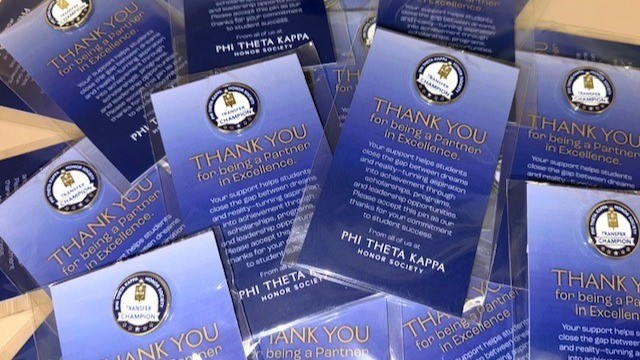
That’s how Dennis M. Kelly opened the first transfer professional development session at the 2026 PTK Catalyst Annual Convention, setting the tone for every conversation that followed.
Across sessions with leaders in transfer enrollment, community college engagement, and higher ed innovation, one message came through loud and clear: transfer students are not a secondary audience; they are a strategic priority.
Here are a few standout takeaways:
Dennis Kelly | VP Enrollment Management – Elmira College (NY) on From App to Cap
- Think boldly about transfer strategy—this is a massive, high-impact population (10M+ community college students, 225K+ PTK members annually)
- Credit is currency: reverse transfer, articulation, and credit efficiency directly impact momentum
- Belonging matters and “sticky” spaces foster it: intentional aid, housing, and engagement help students feel seen across all populations
- PTK students are high-achieving, low-debt “superstars”—one enrolled student can justify the investment in a PTK partnership
- Near-peer connection between transfer students with similar foundational experiences strengthens retention and success
Jamie Blanch | Asst. VP of Admissions – Knox College (IL) on Transfer Student Recruitment Strategy
- Timing, channel, and frequency are critical—be intentional, not noisy
- Segment outreach: text messaging may outperform email or DMs for transfer students
- Build cross-campus “transfer champion” teams to align marketing, admissions, and student support
- Use non-matriculant campaigns during midterms and finals, emphasizing that previously offered scholarships will be honored if students decide to transfer
Chelsea Barclay | Director of Transfer & Graduate Admissions – Nazareth University (NY) on PTK Direct Admission
- PTK Direct Admission extends proven first-year models to high-achieving transfer students, reshaping access and boosting enrollment amid the demographic cliff
- Importing PTK data into CRM enables targeted, action-oriented outreach
- Clarity wins: transparent credit pathways and scholarship info reduce barriers
- PTK Connect lets students signal interest early, increasing confidence and reducing application stress
- Participation growth (9% → 20% of applicant pool) demonstrates the impact of streamlined PTK Direct Admission pathways
Dr. Cara McClintock, PhD | Associate Director, Program for Community College Engagement Princeton University (NJ) on Community College Engagement
- Access means belonging before enrollment—“You are already welcome here” is a simple, powerful message
- Leverage faculty, librarians, and grad students to engage and share experience
- Inviting community college students to campus events, performances, lectures, libraries, STEM labs are a low-cost, high-impact way to showcase your institution and guild early affinity for transfer recruitment
- Strengthen partnerships with advisors, honors directors, and PTK chapters through newsletters, virtual, and on-campus events
- AI must remain transparent, explainable, and human-centered
- Data integrity, privacy, and governance are non-negotiable
- AI should augment—not replace—human decision-making
- Systems must handle diverse transcripts and multilingual needs
- The real value of AI is insight, prediction, and actionable intelligence—not just extraction
Across every session, one theme was clear: smarter systems + stronger partnerships + intentional design = better transfer outcomes.
Final question: What would change at your institution if transfer students were treated as your most strategic growth population—not a secondary pipeline?
If you’re interested in exploring how to strengthen your transfer recruitment strategy and enroll more transfer-bound Phi Theta Kappa Honor Society International members, we’d love to connect.
📩 Reach out to us at collegerelations@ptk.org to explore partnership opportunities.